Like any toxic relationship, we complain about it constantly…
and then somehow end up right back in it six months later.
A week ago, in the middle of the night, something happened.
We knew it would happen — as it does every year.
The government reached into our homes and stole an hour of our lives.
No negotiation.
Just gone.
Which feels less like “saving daylight” and more like daylight committed a felony.
And every single year when this happens, we all go through the same routine.
We wake up tired.
We complain about it.
We struggle through the week like zombies.
Then someone inevitably says:
“It’s only an hour.”
Only an hour!
Tell that to every parent trying to get their kids to bed or wake them for school.
Every shift worker struggling to stay awake.
Every neurodivergent brain that just had its routine thrown into a blender.
And yet — despite the collective complaining of an entire nation twice a year — we keep doing it.

So naturally, I had to ask the obvious question:
Why?
Why do we still do this?
Because the answer is both fascinating… and ridiculous.
So Where Did This Even Come From?
Most people assume Daylight Saving Time was invented by Benjamin Franklin.
That’s not entirely accurate.
Benjamin Franklin actually wrote about the idea in 1784 — but was he joking?
I mean, he also suggested firing cannons at sunrise to wake people up, taxing window shutters, and rationing candles.
Yes. The entire concept was originally part of a satirical essay suggesting people could save money on candles if they just woke up earlier.
Somehow, that joke eventually turned into public policy.
The first serious proposal didn’t come until 1895, when a New Zealand scientist named George Hudson suggested shifting the clocks so people could have more daylight in the evenings.
A few years later, a British builder named William Willett began campaigning hard for the idea in England.
Then World War I happened.
In 1916, Germany became the first country to actually implement daylight saving time as a way to conserve fuel during wartime. Other countries quickly followed, including the United States in 1918.
At the time, it actually made some sense.
Electricity was expensive.
Fuel mattered.
Factories needed daylight to operate efficiently.
However —
The war ended.
Technology changed.
Electric lights became normal.
Air conditioning, LED lighting, smartphones, and computers all entered the picture.
And somehow… Daylight Saving Time stuck around.
In 1966, the United States passed the Uniform Time Act, which standardized Daylight Saving Time across most of the country.
But not everyone bought into the idea.
Two states looked at the whole thing and basically said:
“Yeah… we’re not doing that.”
Arizona and Hawaii (except the Navajo Nation) have wisely chosen to ignore the entire clock-changing circus.
Meanwhile, the rest of us are still wandering around our houses twice a year trying to remember how to reset the stove clock.
Which raises an even bigger question.
If this system was created to solve problems that existed over 100 years ago…
Why are we still pretending it’s necessary now?
But Here’s Where It Gets Personal
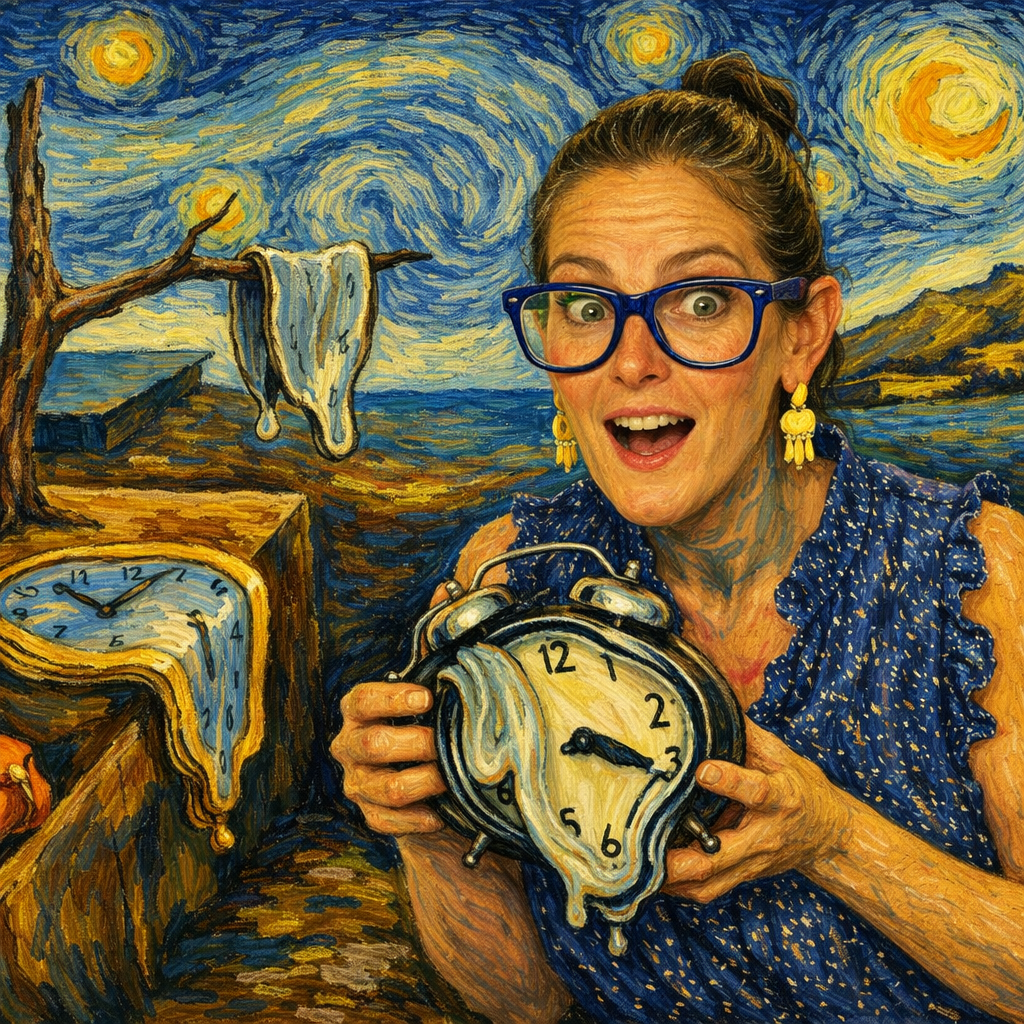
So to recap:
Daylight Saving Time started as a joke, became a wartime energy-saving strategy, and somehow survived into an era where refrigerators and washing machines can connect to Wi-Fi.
Makes perfect sense.
Except for the part where it doesn’t.
And while most people roll their eyes and move on after the clock change…
For people like me, the impact is a little more complicated.
As a person who thrives on routine, Daylight Saving Time is one thing I dread every year.
To most people it is just an inconvenience.
To me it is additional chaos for my brain to try to conform to.
I have a million alarms set throughout the day that help me be a functioning adult.
These alarms tell me when:
- To take my medication and vitamins (four alarms per day).
- I need to get out of bed (three alarms per day — the first one is a suggestion if I want to be extra productive that day, the second one gives me just enough time to get through my morning routine without rushing, and the third one is last call to jump out of bed and scramble to make it to work on time).
- To wake my boys up for school (two alarms, one for each of my boys).
- To wrap up what I’m doing and head to the bus stop (one alarm).
- To remind Zedekiah to plug in his school computer (one alarm).
- It’s time for us to brush our teeth and put our retainers in (one alarm).
And that’s just the scheduled alarms.
That doesn’t even include the thousands of reminders scattered throughout day.
Concept of time — and time blindness — is difficult to explain and equally as difficult to understand.
Even more difficult is living with very little concept of time and an abundance of time blindness.
Especially when forced to move the clock forward or backward an hour every six months.
My alarms may not teach my brain the concept of time. They replace it in more of a Pavlovian way — minus the drooling.
When my alarms go off in the morning it’s still dark outside, signaling my brain that it is time to start the day. (Okay, I might be drooling in my sleep, but not because of the alarm 🤪.)
The midday alarms signal that half the day is gone.
The nighttime alarms — again, when it’s dark — tell my brain it’s time to start quieting down for sleep.
Then Daylight Saving Time hits.
BAM!
Suddenly my morning alarm goes off and it’s light outside.
That instantly sends me into panic mode — my brain thinking I slept through an alarm — leaving me unable to figure out what time or even what day it is.
And once that panic bomb goes off, my entire day is wrecked.
My brain spends the entire day stressing over what time it is, checking the clock constantly, and ruminating about forgetting something.
Which leaves very little energy for focusing on the things I’m supposed to be doing and zero energy to accomplish anything.
Creating even more chaos.
Now you might think:
“Well the days get longer whether we change the clocks or not. So even if the time didn’t change, the sun would eventually be out earlier.”
And you would be right.
But eventually is the key word.
Eventually is a gradual change that my brain has a better chance of adapting to.
Eventually is not a shove into a whole new time dimension overnight.
Eventually doesn’t hijack the circadian rhythm that has taken me almost forty years to figure out.
Literally — Changing All the Clocks
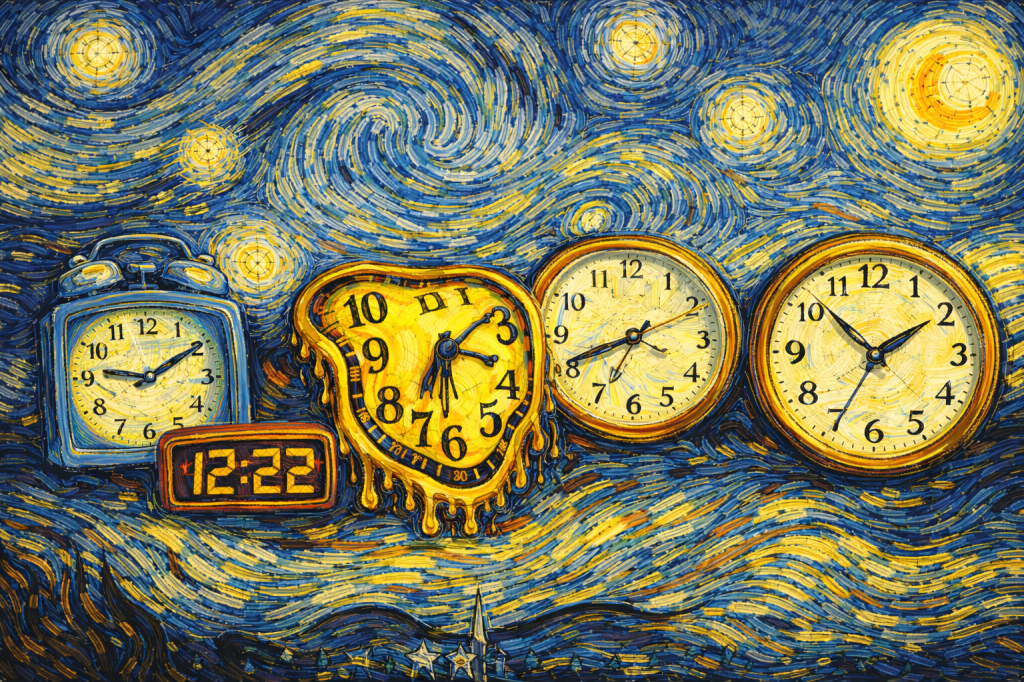
My car.
The stove.
The random ones I forgot even existed until they are wrong.
Shoot — I don’t even set the microwave clock anymore (luckily it doesn’t blink if it is not set).
I also have plant lights on timers that I have to manually reset.
Well… I have one I reset.
The others I just leave wrong until we have company staying over. They are in the spare room and nobody needs to know my plants are living on a different time zone.
Setting clocks is not a difficult task — simple, really.
Yet to my brain — daunting.
Could I just reset the clocks and go about my day? Sure.
Unfortunately, my brain does not think so.
My brain immediately goes:
“This is stupid. Why are we still doing this? It makes no sense.”
And then it plays that thought on repeat.
Because my brain hates conforming to things that make no sense!
And honestly?
My brain is not wrong.
The Real Question Isn’t If We Should End It
Here’s the frustrating part.
Ending the clock change is one of those rare things that people across the political spectrum seem to agree on.
Yet somehow… it still hasn’t happened.
Why?
Because once lawmakers start debating which time to keep, the agreement falls apart.
In 2022, the U.S. Senate actually passed the Sunshine Protection Act unanimously.
But when the bill reached the House of Representatives, lawmakers started questioning whether permanent DST was the right choice.
Some people want permanent daylight saving time for longer evenings.
Others — including many sleep scientists — say permanent standard time is healthier for our bodies.
So instead of picking one and moving forward…
The debate stalled.
The bill died.
And we continued to mindlessly conform to changing the clocks twice a year.
At this point, the conversation around Daylight Saving Time isn’t new.
Research has been done.
Arguments have been made.
Bills have been proposed.
And yet here we are.
Daylight Saving Time might be the only policy in America that almost everyone complains about twice a year… and yet we still keep doing it.
That should probably tell us something.
If the government can change the clocks in every house in the country twice a year, they should be able to figure out how to stop doing it too.
Which brings us to the real question:
What would it actually take to end the nonsense?
What Actually Has to Happen
Ending the clock change isn’t impossible.
It’s actually a legislative decision.
For my state — North Carolina — it starts with the North Carolina General Assembly.
State lawmakers have the power to adopt permanent standard time.
If the state wanted to stay on permanent daylight saving time instead, Congress would need to approve it at the federal level through legislation such as the Sunshine Protection Act.
Regardless, this problem has a solution.
But solutions require something most of us skip right over.
Action.
If this is something that actually bothers you — not just for a week after the clock change but every year — then it might be worth doing more than complaining about it at the coffee machine.
Call your state representative.
Email your state senator.
Tell them that ending the twice-a-year time change should be a priority.
Because if millions of people hate something, but no one actually asks lawmakers to fix it… Nothing changes!
At The End of the Day
Daylight Saving Time isn’t just about moving a clock.
For some people it’s a minor annoyance.
For others — especially those of us whose brains rely heavily on routine and structure — it’s like someone quietly rearranged the entire operating system overnight.
And the strangest part is that we all know it doesn’t make much sense anymore.
It was created for a different world, solving problems that mostly don’t exist today.
Yet twice a year we keep resetting our clocks, resetting our routines, and resetting our sleep schedules as if this is just the way things have to be.
Maybe it doesn’t.
Maybe the most absurd part of Daylight Saving Time isn’t the history behind it.
Maybe it’s the fact that millions of people complain about it every single year… and yet we still keep doing it.
Let This Year Be Different
Instead of just complaining about it among ourselves —
let’s actually let the people who have the power to change it hear from us.
Because if something feels a little insane…
continuing to do it year after year probably isn’t the solution.
TIRED OF THE CLOCK CHANGE TOO?
CONSIDER CONTACTING YOUR REPRESENTATIVES
Click the arrow to find your representatives and a premade message to send!
Find your representatives here:
• U.S. Senators – https://www.senate.gov/senators/senators-contact.htm
• U.S. House Representative – https://www.house.gov/representatives/find-your-representative
• State legislators – https://www.usa.gov/elected-officials
It only takes a minute to send a message.
Here is a cut and paste message to send — no excuses needed — just add your city/state:
Hello,
As a constituent of (ENTER YOUR CITY/STATE HERE), I am writing to ask that you support legislation that would end the twice-a-year clock change associated with Daylight Saving Time.
The time change disrupts sleep, health, and daily routines for millions of Americans. I encourage you to support efforts that would establish a permanent time standard.
Thank you for your attention to this issue.
Short messages like this are perfectly fine — offices mostly count how many people contact them.
If you are drafting a letter of your own, be sure to mention your city or ZIP code and mention you are a constituent.
Mentioning that you’re a constituent is an important part of contacting lawmakers. Their offices prioritize messages from people who live in their district or state because those are the voters they represent.
If you actually send a message to your representatives — THANK YOU!
Complaining is easy.
Taking action is what actually brings change.
– sorry NOT sorry –

 Sorry - I'm All Out ofApologies
Everybody has their own perspective, let’s hear yours –